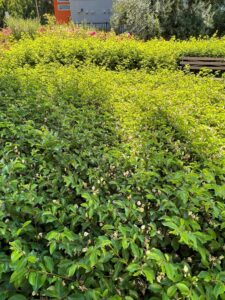
- Study Organism: Crossberry bushes (Grewia occidentalis)
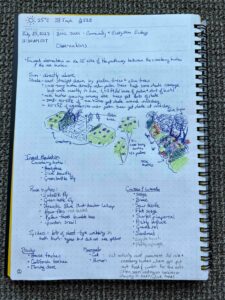
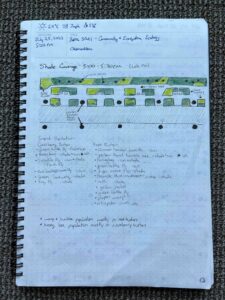
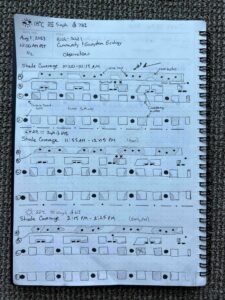
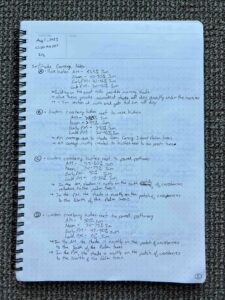
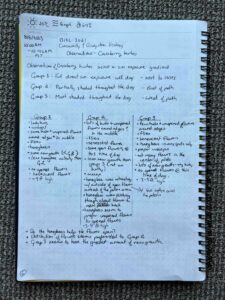
- Observed crossberry bushes across a sun exposure gradient. I characterized the direct sun exposure vs shade coverage at 4 time points (10AM, 12PM, 2:15PM and 5PM). 3 distinct sun/shade profiles were noted and used as my 3 locations along the gradient. Group 1: the crossberry bushes next to the rose bushes get full direct sun exposure for most of the day. Group 2: the crossberry bushes East of the path are lightly shaded throughout the day with longer morning and afternoon sun exposure than Group 3. Group 3: the crossberry bushes West of the path get the most shade throughout the day . I observed the 3 groups between 10:00AM-10:40AM. It was a sunny day, 20C, 6mph winds, 64% humidity.
Observations:
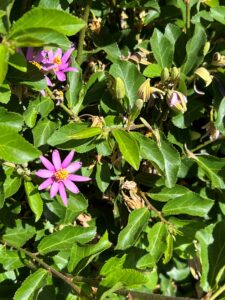
- At this time of day, flowers are mostly closed. All flowers in Group 1 and Group 3 are closed. Some flowers were open in Group 2.
- Distribution of flowers seems preferential to Group 2. Group 2 has an abundance of flowers around the edges and in the middle. Group 1 has some flowers around the edges and the middle. Group 3 has a few flowers around the edges, but no flowers apparent in the middle.
- Group 3 seems to have the greatest amount of new growth, there was a lot of new leaves and the bushes reached upward of 5 ft. Group 1 and 2 did not show nearly as much new growth as Group 3 and only reached about 4 ft. *The bushes are cut back a couple times a year and the height they are cut back to is not necessarily consistent between plots.
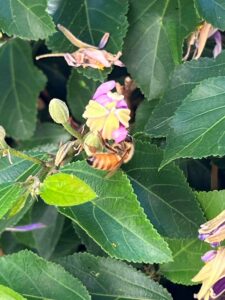
- Noticed the honeybees seemed more interested in the closed flowers rather than the open ones. They would work to push the calyx’s back. When they were on the open flowers, they were focused on the area between the petal and the calyx.
- Honeybees were observed over plots that had direct sunlight.
- Patterns: I find the abundance of flowers in Group 2 to be a point of interest. It suggests that for flowering, these plants are preferential to light shade, receiving direct sun for 3-5 hours a day. However, if you want to see more vertical growth, they grow quickly in partial shade when receiving up to 2 hours of direct sunlight a day. Too much sun negatively impacts both the maximum flower capacity and the growth potential.
Hypothesis: The Crossberry bush (Grewia occidentalis) produces it’s maximum amount of flowers in a light shade environment. I predict that there will be a significantly greater amount of flowers produced in a Crossberry plot with light shade than in plots with full sun or partial shade.
- Response variable: number of crossberry flowers
Explanatory variable: Amount of shade
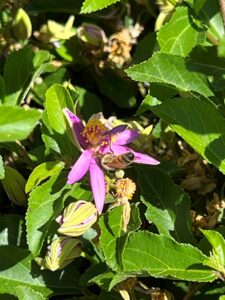
Great post and start to your project. Very detailed observations and I love your field journal. Remember your hypothesis would be more like the number of flowers is influenced by the amount of sunlight. Your prediction will be more specific. Have a look through the tutorial as you are writing up your small assignment.
Thanks for the feedback. So my hypothesis was more of a prediction, and should have been more big picture, but my prediction was okay?
yes, your prediction looked good. Sorry I missed your question earlier.
Hello,
I really liked that way you presented the whole blog. Your field journal is also looking great. But I agree with PREUDINK that you need to work on your hypothesis and prediction.
Your hypothesis is sounding more like a prediction. Usually in hypothesis we try to establish link between the two variables and in prediction we predict what the link is going to be. You can state it like that “Crossberry bush (Grewia occidentalis) flowers and sun shade have a positive correlation or Crossberry bush produce more flowers in sun shade.
I hope it helps and overall I really liked you blog.